The rat or mouse you saw last night is probably not alone, and as long as the gap it came through stays open, more will follow. So we start with the way in, then deal with the ones already inside.
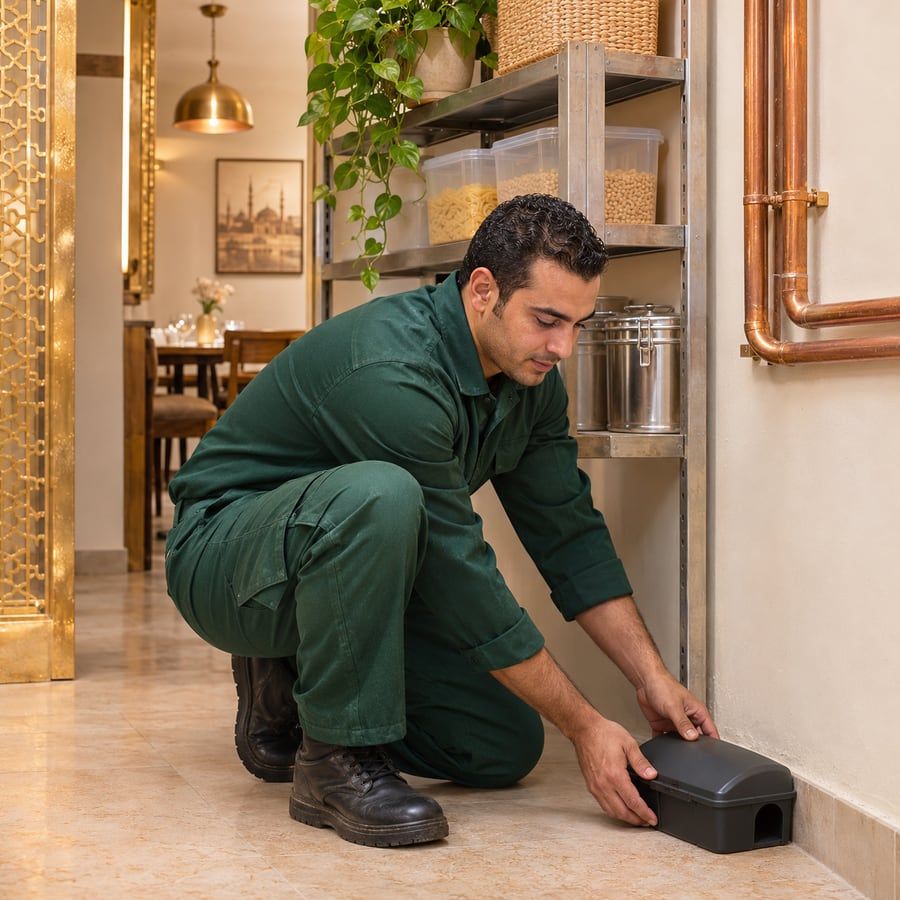
Our rodent control is two steps done together: we find how the rats or mice get in and seal it, and we set secured traps and bait along their paths, beside walls and behind appliances. Sealing gaps with no traps locks the rodent inside. Traps with the gaps left open let new ones move in to replace those we caught.
Signs of rats and mice
Scratching at night
The sound of running or gnawing above a false ceiling and inside walls and cupboards. It gets louder once the house goes quiet.
Small black droppings
You find them along walls, in kitchen drawers, and behind the stove and fridge. Shiny droppings mean a rodent passed through recently.
Chewed food and wires
Bags torn open at the corner and electrical wires with tooth marks. A rodent's teeth never stop growing, so it keeps gnawing whatever is in front of it.
A greasy line on the wall
Rats and mice take the same route every night, and their bodies leave a dark shine on the wall at corners and openings.
A sharp smell
The smell of rodent urine shows up in closed spaces, such as under the sink, in the storeroom and in the tool cupboard.
Shredded paper and fabric
Rodents build nests from torn fabric and cardboard, usually somewhere warm where nothing gets moved.
How do rats and mice get in?
A small mouse can get through a very narrow gap, so a closed door is not enough. Most of them come in through pipe openings under the sink, through the sewer pipes themselves on ground floors, or through cracks in the wall around an air conditioner or gas line.
On ground floors and in basements and warehouses, the problem arrives faster. In shops and restaurants, food that is always available makes rodents settle in and breed instead of passing through.
The damage goes beyond how it looks. Rats and mice contaminate food and surfaces with urine and droppings, and a chewed wire can cause an electrical short. If you have children or stored food, do not put this off.
Where we look
Under the sink and around sewer pipes
Behind the fridge and stove
Above the false ceiling
Basements and storerooms
Air conditioner openings and gas lines
Building entrances and air shafts
How does rodent control work?
1
We talk through the problem by phone
We ask what you saw and where, what kind of place it is, and whether you have children or pets. Then we give you the price and agree on a time.
2
We find the route and the way in
During the visit, our rat exterminator follows the droppings, grease marks and gnawing to find the gaps the rodents are using.
3
We seal the entry points
We seal the gaps that can be sealed. If one needs plumbing or carpentry work, we explain it to you so it does not get left open.
4
We set traps and bait
Traps go along the rodent's path beside the wall and bait goes in secured boxes, never anywhere a child or a pet can reach.
5
We write everything on the receipt
The product name, where each bait was placed, and the warranty, so you can check it all after the technician leaves.
6
We check in with you
We follow up after the visit. If you find new droppings or hear the sounds again, call us.
Why aren't glue boards and poison enough?
A glue board catches one or two rodents, and a big rat will sometimes avoid it altogether after seeing another one stuck to it. The gap stays open either way.
Poison left out in the open is more dangerous than the rat itself if there is a child or a cat in the house. And if a rat eats it and dies inside a wall, you are left with a smell whose source is hard to reach.
Until we arrive: cover food, lift cardboard off the floor, and wipe up droppings with gloves and disinfectant. Do not sweep them dry, so the dust does not fly up.
Safety with children and pets
Bait goes in closed boxes made for the purpose, set where children and pets cannot reach. Tell us from the start if you have a cat or dog, because that changes where we place things and sometimes the type of trap.
We also write down where each bait was placed, so it does not catch you by surprise when you clean or move furniture. If you find a box has moved from its spot, call us.
Everything is in writing before we start
With rodent control, the worry is promises nobody wrote down. This is the sheet the technician hands you.
Visit sheetElrwad Pest Control
Service
Rodent control
What we do
Finding how rodents get in
Sealing the gaps that can be sealed
Secured traps along their path
Bait in closed boxes
Product
Written here, once the technician chooses the treatment
Price
You get it by phone, it is written down before we start, and it does not go up after you agree
An illustration of what gets written down at the visit.
Questions about rodents
If I just seal the holes, will the rats leave?
No. If a rat is still inside, you lock it in with you and it will gnaw even more to get out. Sealing and traps have to happen at the same time.
How long does rodent control take?
The visit itself varies with the size of the place and the number of entry points. Getting rid of the rats or mice takes a little longer, until all of them are caught, which is why we follow up with you after the visit.
I have a cat at home. Is the bait a danger to my cat?
Tell us about your cat when you book so we can plan around it. We choose suitable spots and use closed boxes, or traps instead of bait, depending on the case, and the technician will show you where everything is.
Do you work in shops, restaurants and warehouses?
Yes, and in those places we pick a time that does not disrupt your work. Call us and tell us what kind of place it is and its size.
What do I do if a rat dies inside the wall?
If you notice the smell, call us. This is why we rely on traps along the path and bait in boxes, and we try not to let it get to that point.
How long is the warranty, and what does it cover?
The warranty is 5 years, written on the receipt with its terms. If the rodents come back during that time, call us and we come back and treat again.
How much does it cost?
It depends on the type of place, its size and how bad the problem is, and you get the price by phone. It is written down before we start, and it does not go up after you agree.